
How We Assign Status Labels
Published 14 Jun 2026 · Updated 10 Jul 2026
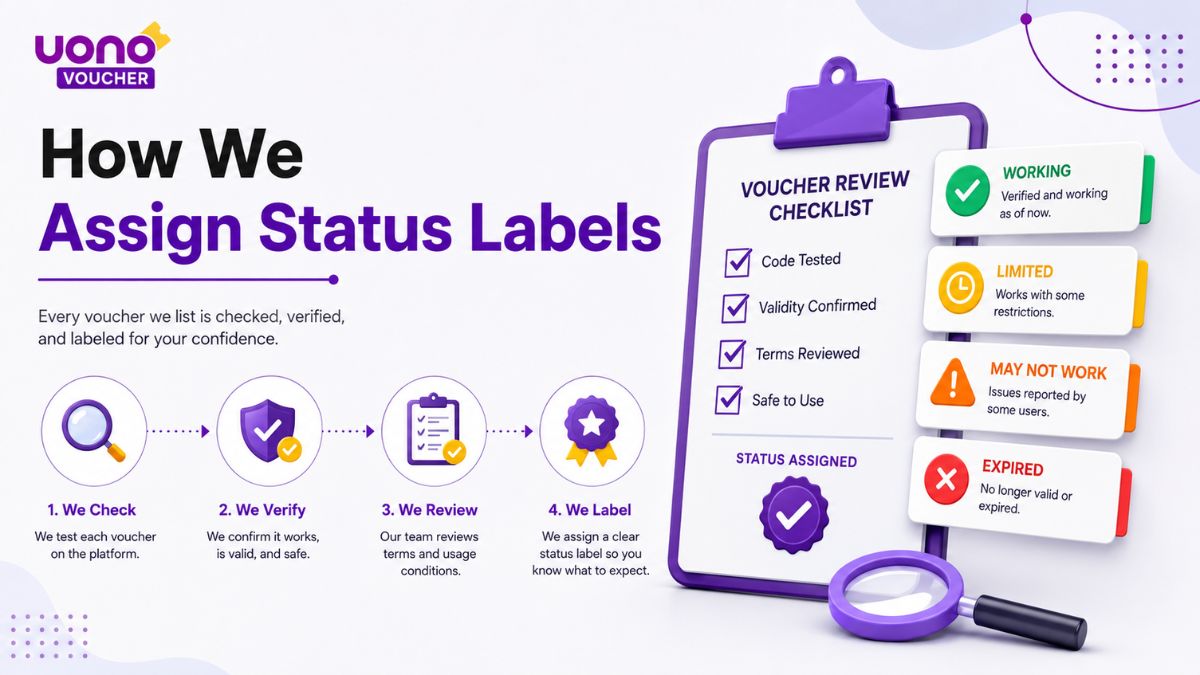
Every game, promo code and voucher record on UonoVoucher carries a status label. These labels help readers understand what was known about a record at the time of its most recent review.
Labels are assigned by the person who last reviewed the record, using the same checklist and evidence standards each time. This process is intended to keep classifications consistent across different reviewers and record types.
Checked and Active require a team member to have directly reviewed or confirmed the record during the current review cycle. Reader reports alone are not sufficient to receive either label.
Reported means that one or more reader submissions support the record, but the information has not yet been independently confirmed. A Reported record may later be promoted to Checked or Active, downgraded to Unconfirmed or reclassified as Expired or Withdrawn.
Expired and Withdrawn are different. Expired generally means a stated validity period has ended. Withdrawn means a code, voucher or promotion appears to have been removed or stopped working before its stated end date.
Status labels are reassessed periodically rather than assigned permanently when a record is first added.
Why status labels are necessary
Promo codes, vouchers and game records can change quickly. A code that worked during one review may later become unavailable because:
- The campaign ended
- A redemption limit was reached
- Eligibility rules changed
- The operator withdrew the promotion
- The application or website was updated
- The offer became restricted to selected accounts
- The original source was removed
- The available evidence became outdated
Without a clear status system, an old record could appear equivalent to one reviewed recently.
The label does not replace the underlying details. Readers should also check the last reviewed date, stated expiry date, source information and any eligibility notes shown on the record.
Status labels at a glance
| Status | General meaning |
|---|---|
| Scheduled | The record relates to an offer or event expected to begin later. |
| Checked | The record details were directly reviewed during the current review cycle. |
| Active | The code, voucher or promotion appeared available during a recent direct review. |
| Limited | The record appears available only under specific conditions or to selected users. |
| Reported | Reader or community reports exist, but independent confirmation is still pending. |
| Unconfirmed | There is insufficient current evidence to classify the record more confidently. |
| Expired | A stated validity period has passed or the campaign has clearly ended. |
| Withdrawn | The promotion appears to have been removed before its expected expiry. |
A record may also include explanatory notes where the label alone does not fully describe the situation.
1. Scheduled
The Scheduled label is used when a promotion, voucher or event has been announced but is not expected to be available yet.
Evidence may include:
- A future start date
- An official campaign announcement
- An upcoming event schedule
- A platform notice showing that activation is pending
- A voucher record created before the opening period
A Scheduled label does not mean that the promotion is guaranteed to begin exactly as announced. Campaigns can be delayed, changed or cancelled before activation.
When the expected start date arrives, the record should be reviewed again. It may then become:
- Active
- Checked
- Limited
- Unconfirmed
- Withdrawn
A scheduled record should not be presented as currently redeemable.
2. Checked
The Checked label means a reviewer directly examined the record during the current review cycle.
The reviewer may have confirmed details such as:
- The platform or game name
- The visible promo-code text
- The original source
- The campaign dates
- The status displayed by the platform
- The destination of an official link
- Whether the record still appears in the relevant promotion area
Checked describes the review of the record itself. It does not necessarily mean that a voucher was successfully redeemed on every account type.
A Checked label may be used when the record details can be verified but universal availability cannot be established.
For example, a reviewer may confirm that a promotion is still listed, while the platform does not provide enough information to classify it as broadly Active.
3. Active
The Active label is used when the available evidence indicates that a code, voucher or promotion was currently available during a recent direct review.
To assign Active, reviewers generally look for more than the continued existence of an old page.
Relevant evidence may include:
- A current official promotion listing
- An in-app voucher record
- A redemption interface that still recognises the campaign
- A current start and end period
- A recent direct check
- Consistent details across official platform pages
- No clear indication that the promotion has ended
Reader reports may support an Active classification, but they do not replace direct review.
An Active label does not guarantee that the code will work for every user. Availability can still depend on:
- Region
- Account age
- Registration date
- User selection
- Application version
- Previous redemption
- Device eligibility
- Campaign limits
- Other platform conditions
Active means the promotion appeared current when checked, not that every account is guaranteed access.
4. Limited
The Limited label is used when a record appears to remain available but only under specific conditions.
A promotion may be marked Limited when it is restricted to:
- New users
- Selected accounts
- A particular country or region
- A specific application version
- Invited users
- A limited claim quantity
- A defined registration period
- One redemption per account or device
- A particular campaign group
- Users who received an in-app notification
Limited is not the same as Expired.
A limited code may still work for eligible users while failing for others. Where known, the record should state the relevant restriction.
When the exact limitation cannot be confirmed, the accompanying note should make that uncertainty clear.
5. Reported
The Reported label means that a record has reader submissions, community reports or another source of user-provided information behind it, but the details have not yet been independently confirmed by a reviewer.
Reported evidence may include:
- A reader stating that a code worked
- Several users reporting the same campaign
- A screenshot submitted by a reader
- A report that a promotion has stopped working
- A message about a new voucher
- A report of changed eligibility conditions
Reader reports are useful, but they can be incomplete or account-specific.
For example:
- The code may only work in one region
- The screenshot may be old
- The account may have received a targeted offer
- The user may have entered a different code
- The campaign may have changed after the report
- The result may not be reproducible
A Reported record should therefore not be presented as independently verified.
After review, it may become:
- Checked
- Active
- Limited
- Unconfirmed
- Expired
- Withdrawn
6. Unconfirmed
The Unconfirmed label is used when there is not enough current evidence to assign a more definite status.
A record may be Unconfirmed because:
- The original source cannot be found
- The last review is too old
- Available reports conflict
- The platform no longer displays clear information
- The code cannot be tested safely or consistently
- Eligibility restrictions are unknown
- The promotion details are incomplete
- A Reported record could not be independently verified
- The operator provides no clear expiry information
Unconfirmed does not automatically mean false or expired. It means the available evidence is insufficient.
Readers should treat an Unconfirmed code cautiously and verify it through the platform's current promotion section before relying on it.
An old Active record may also be downgraded to Unconfirmed when it has not been rechecked within the expected review period.
7. Expired
The Expired label is used when the promotion's validity period has ended or there is clear evidence that the campaign concluded normally.
Evidence may include:
- The displayed expiry date has passed
- The official campaign page says the promotion ended
- The redemption interface identifies the code as expired
- The campaign was tied to a completed event
- The platform replaced it after the stated end date
- The original terms define a period that has ended
An expired record may remain visible for transparency and historical reference.
Keeping expired records can help readers:
- Identify old codes still circulating online
- Understand why a code no longer works
- Distinguish past campaigns from current ones
- Compare earlier and newer offers
- Avoid retrying a clearly ended promotion
The presence of an expired record does not mean that readers are encouraged to attempt it.
8. Withdrawn
The Withdrawn label is used when a promotion appears to have been removed before its stated or expected expiry.
This can happen when:
- The operator ends the campaign early
- The code is removed from the platform
- The official promotion page disappears
- The platform states that the offer was cancelled
- Several reports indicate that it stopped working before the end date
- The operator replaces the offer unexpectedly
- Eligibility is reduced so substantially that the original listing is no longer accurate
Withdrawn should not be assigned solely because one reader was unable to redeem a code.
A failed redemption can result from account restrictions, previous use, region, application version or another eligibility issue.
Reviewers should look for supporting evidence that the promotion itself was removed rather than unavailable to one account.
The difference between Checked and Active
Checked and Active are related but not identical.
Checked means the record was directly reviewed and its details were examined.
Active means the available evidence also indicates that the promotion was currently available at the time of review.
A record may be Checked but not Active when:
- The details are accurate, but current redemption cannot be established
- The campaign page still exists but availability is unclear
- The offer is visible only to selected accounts
- An expiry date is missing
- The platform provides conflicting information
In such cases, Checked, Limited or Unconfirmed may be more accurate than Active.
The difference between Reported and Unconfirmed
Both labels indicate that a record is not currently confirmed as Active, but they describe different evidence conditions.
Reported means that there is a specific reader or community submission behind the record.
Unconfirmed means the available evidence is insufficient, unclear, outdated or conflicting.
A Reported record may become Unconfirmed when:
- Review attempts fail
- The submitted source cannot be verified
- The screenshot is too old
- Reports conflict
- No current platform evidence can be found
A previously Active record can also become Unconfirmed even when no reader report is involved.
The difference between Expired and Withdrawn
The distinction is based primarily on how the promotion ended.
Expired means the promotion reached the end of its stated or clearly defined validity period.
Withdrawn means the promotion appears to have been removed before that expected end.
Example:
- A voucher valid until 30 June that stops on 30 June is Expired.
- The same voucher being removed on 20 June may be Withdrawn, provided the early removal can be supported by reliable evidence.
When there is no stated end date and a code simply stops working, the reviewer may initially use Unconfirmed until stronger evidence supports Withdrawn.
Evidence reviewers consider
Reviewers may consider several types of evidence when assigning or changing a label.
Official platform information
This normally carries the most weight.
Examples include:
- A current in-app promotion page
- The operator's official website
- Published campaign terms
- An official support notice
- A clearly identified promotion screen
- An official announcement from a verified channel
An official page must still be reviewed carefully. Old campaign pages may remain online after a promotion ends.
Direct review
A direct review involves a team member checking the record during the current review cycle.
The review may examine:
- Whether the code is recognised
- Whether the promotion is still visible
- Whether the dates are current
- Whether the destination link remains official
- Whether eligibility notes are displayed
- Whether the record information matches the platform
A direct check may not include completing every possible redemption step, especially when doing so would require personal account activity or conditions unavailable to the reviewer.
Reader reports
Reader reports can indicate that:
- A code worked
- A code failed
- A promotion disappeared
- Eligibility changed
- A regional restriction exists
- The application displays a new message
Reports are treated as supporting evidence rather than automatic confirmation.
Reviewers consider:
- How recent the report is
- Whether multiple independent reports agree
- Whether the report includes useful context
- Whether the account was eligible
- Whether the code was entered correctly
- Whether the claim can be compared with official information
Dates and record history
Reviewers examine:
- Publication date
- Last reviewed date
- Stated start date
- Stated expiry date
- Previous label changes
- Known campaign updates
- The age of supporting screenshots or reports
A recent webpage update date does not necessarily mean the promotion itself is current.
Consistency across sources
A record is more reliable when current details agree across relevant sources.
Conflicts may include:
- Different expiry dates
- Different code spellings
- Different eligibility requirements
- One source saying Active while another says ended
- A page referring to an outdated application version
When reliable sources conflict, the record may remain Unconfirmed until the discrepancy can be resolved.
Evidence that is not enough by itself
The following may justify further review, but normally should not be treated as sufficient evidence for Active or Withdrawn on their own:
- One anonymous comment
- An undated screenshot
- A copied list on an unrelated website
- A search-result snippet
- An old social post
- The continued existence of a campaign URL
- One failed redemption
- One successful redemption with no account context
- A code repeated across many copied pages
- A page claiming that a code is "guaranteed."
Popularity is not the same as verification. Repetition across multiple websites may originate from a single outdated source.
How labels are updated
A status label may change when new evidence becomes available.
Common transitions include:
| Previous status | New status | Typical reason |
|---|---|---|
| Scheduled | Active | The campaign started and was directly confirmed. |
| Scheduled | Withdrawn | The campaign was removed or cancelled before activation. |
| Reported | Checked | A reviewer confirmed the submitted record details. |
| Reported | Active | Direct review showed that the promotion was current. |
| Reported | Unconfirmed | The submission could not be independently verified. |
| Active | Limited | New restrictions or account-specific conditions were identified. |
| Active | Unconfirmed | The record became too old or current availability became unclear. |
| Active | Expired | The stated campaign period ended. |
| Active | Withdrawn | The promotion was removed before the expected end date. |
| Unconfirmed | Active | New current evidence confirmed availability. |
| Unconfirmed | Expired | Reliable evidence showed that the campaign ended. |
| Withdrawn | Active | The operator restored or relaunched the same promotion. |
Where a promotion is relaunched with materially different terms, it may be more appropriate to create a new record rather than restore the old one.
Review cycles and the last reviewed date
Status labels are tied to review cycles.
The last reviewed date shows when a team member most recently reassessed the available evidence. It should not be confused with:
- The date the code was first published
- The promotion's start date
- The expiry date
- The date a reader submitted a report
- The date a webpage was indexed
The acceptable age of a review may vary depending on the record.
A short-term campaign may require more frequent review than a general game-information page. Records with approaching expiry dates, conflicting reports or high reader activity may also be prioritised.
An old review date reduces confidence even when the label still says Active. Readers should consider the label and date together.
What happens when a review is overdue
When a record has not been checked within the expected cycle, reviewers may:
- Prioritise it for rechecking
- Add a note explaining that the evidence is old
- Downgrade Active to Unconfirmed
- Leave the record visible but disable copying
- Remove unsupported eligibility claims
- Retain the historical information while clarifying that current availability is unknown
A record should not remain Active indefinitely only because it was confirmed once in the past.
Handling conflicting reader reports
Reader reports do not always agree.
One user may report success while another reports failure. This can happen because of:
- Regional restrictions
- Different account types
- Previous use
- Targeted eligibility
- Application versions
- Typing errors
- Claim limits
- Different review times
- Campaign changes between attempts
When reports conflict, reviewers look for context rather than counting votes alone.
A code with mixed reports may be:
- Active, when official evidence remains current
- Limited, when the difference can be explained by eligibility
- Reported, when submissions exist but verification is pending
- Unconfirmed, when the cause cannot be established
- Expired or Withdrawn, when stronger evidence shows the campaign ended
Handling regional and account-specific availability
A code should not be classified as universally Active when it is known to work only for a narrow group.
Where evidence supports a restriction, the record should be marked Limited and should state the known condition, such as:
- India only
- Selected users
- New accounts only
- Application version required
- One claim per device
- Invite-only campaign
- Available to users who received the promotion directly
Where the restriction is suspected but not verified, the record may remain Unconfirmed or Reported with an explanatory note.
Handling technical errors
Temporary platform errors can make an Active promotion appear unavailable.
Before changing a label based on a failure, reviewers may consider:
- Whether the platform is under maintenance
- Whether unrelated features are also unavailable
- Whether the error is temporary
- Whether the promotion page still displays current terms
- Whether other recent reports show the same issue
- Whether the problem affects one account or the campaign generally
A temporary loading error should not automatically change Active to Withdrawn.
Where the cause is unclear, Unconfirmed may be the more accurate temporary classification.
Handling removed or inaccessible sources
An inaccessible source does not always mean that the promotion has ended.
A page may be unavailable because:
- Its URL changed
- The platform is under maintenance
- Access is region-specific
- The campaign moved into the application
- The source requires an eligible account
- The page was removed after expiry
- The platform changed domains
Reviewers should try to locate current official information before changing the label.
When the source cannot be found and no reliable current evidence exists, the record should generally become Unconfirmed rather than automatically Withdrawn.
How reader submissions affect labels
Reader submissions can trigger a new review but do not directly control the final classification.
A useful submission may include:
- The exact code or voucher name
- The platform name
- The date and approximate time
- The status message displayed
- Region or country
- Whether the account was new or existing
- The application version
- A screenshot with sensitive information removed
- A link to an official promotion notice
Readers should not submit:
- Passwords
- One-time verification codes
- Payment details
- Identity documents
- Full account numbers
- Private messages containing personal information
A submission is stronger when it provides enough context to distinguish expiration from account ineligibility.
Corrections and label disputes
A label may occasionally be incorrect because campaigns change quickly or available evidence is incomplete.
When a reader believes a status is wrong, the report should explain:
- Which record is affected
- The current displayed label
- Why the label appears incorrect
- When the issue was observed
- What evidence supports the correction
The record should then be reassessed using the same standards applied during routine reviews.
A reader report should not be rejected merely because it conflicts with an existing label. At the same time, one report should not automatically override stronger current evidence.
What status labels do not guarantee
A status label does not guarantee:
- That a code will work for every user
- That the operator will keep a promotion available
- That the campaign has unlimited claims
- That every account is eligible
- That the platform will not change its terms
- That a game or application is suitable for every user
- That an external website is safe merely because a record exists
- That a promotion is legally available in every location
- Any particular account, promotional or financial outcome
Labels describe the evidence available at a point in time. They are not endorsements or guarantees.
Status-label review checklist
Before assigning or updating a label, a reviewer should check:
- The exact platform, game, code or voucher name
- The original or most authoritative source available
- The current promotion status
- Start and expiry dates
- The last reviewed date
- Regional or account restrictions
- Recent reader reports
- Whether the application or platform version changed
- Whether the record is still traceable
- Whether conflicting evidence exists
- Whether the label accurately reflects uncertainty
- Whether an explanatory note is needed
The reviewer should select the most precise label supported by the available evidence, not the most optimistic one.
Reader checklist
When viewing a record, consider:
- What is the current label?
- When was the record last reviewed?
- Is an expiry date shown?
- Are eligibility restrictions listed?
- Is the evidence direct, reader-reported or unconfirmed?
- Does the platform currently display the promotion?
- Is the code intended for your region and account type?
- Has the promotion reached a claim limit?
- Is the record historical rather than current?
- Does the platform show a different status?
When the label, date and platform information conflict, treat the record cautiously.
Editorial principles behind the label system
The UonoVoucher status system follows several general principles.
Evidence before certainty
A record should not be labelled Active merely because the code appears plausible or has been copied across several websites.
Direct review before promotion
Reader reports may create a Reported record, but direct confirmation is normally required before it becomes Checked or Active.
Uncertainty should be visible
When current evidence is missing, Unconfirmed is more accurate than leaving an outdated Active label in place.
Restrictions should be disclosed
Where a promotion is only available to particular accounts or regions, Limited is more accurate than Active without explanation.
Historical records should remain understandable
Expired and Withdrawn records may remain visible when doing so helps readers identify outdated campaigns. Their closed status should be clear.
Labels should remain reversible
A classification may change as new evidence appears. No label should be treated as permanent.
Final reminder
Status labels are evidence-based summaries, not guarantees.
Checked and Active require direct review during the current review cycle. Reported indicates that reader submissions exist but still require verification. Unconfirmed means there is not enough reliable current information.
Expired describes a campaign that reached its end, while Withdrawn describes one that appears to have been removed early.
Always read the status together with the last reviewed date, expiry date, eligibility notes and current platform information.
Read our Code Review Policy, check whether a Uono voucher has expired, learn why a promo code may not work, review app permissions before installation, and browse current voucher records and promo-code records.
Frequently Asked Questions
The person who most recently reviews the record assigns or updates its label using the site's standard review checklist.
A reader report can trigger a review and support the evidence, but reader reports alone are not normally sufficient for an Active label.
Checked means the record was directly reviewed. Active means the review also found current evidence that the promotion appeared available.
No. A code may still be limited by region, account type, registration date, previous use, application version or campaign limits.
Reported means that one or more reader or community submissions support the record, but the information has not yet been independently confirmed.
This may happen when reviewers cannot verify the submitted information, when reports conflict or when the supporting evidence is outdated or incomplete.
Limited means that a code or voucher appears available only to certain users, regions, account types or campaign groups.
Expired means the promotion reached its stated or clearly defined end. Withdrawn means it appears to have been removed before that expected end.
Yes. An operator may restore or relaunch a promotion. Reviewers must confirm the current campaign details before changing the label.
Expired records may be retained for transparency, historical context and to help readers recognise old codes still circulating online.
Review frequency depends on the type of record, campaign duration, expiry date, reader activity and available evidence. Short-term or changing promotions may require more frequent review.
No. It shows when the record was most recently reassessed. The publication, campaign start and expiry dates may be different.
Normally, no. A failed attempt may result from account eligibility, region, previous use or a temporary error. Stronger supporting evidence is needed.
The record may be labelled Unconfirmed until reliable current evidence can be found.
Yes. A correction report should identify the record, explain the apparent issue and provide current supporting context without including sensitive account information.