
What to Do When Reader Reports Conflict
Published 30 Jun 2026
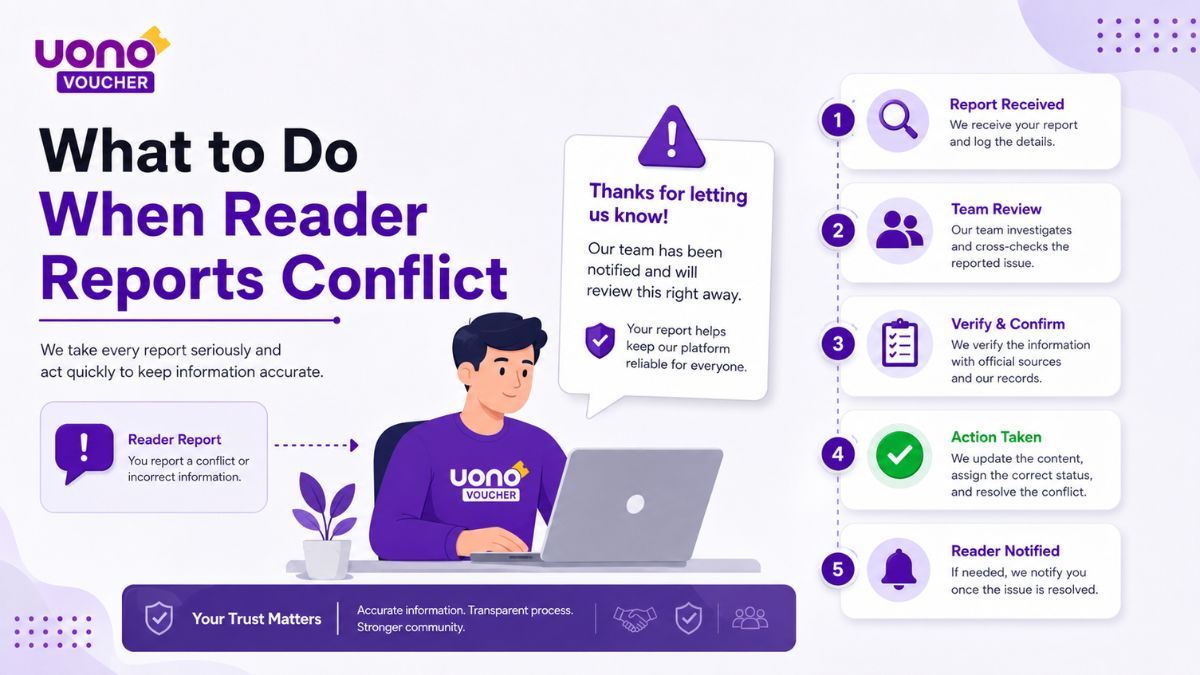
It is common for one reader to report a promo code as working while another reports that the same code failed. This does not automatically mean that either report is inaccurate.
Different results can reflect genuine differences in:
- Country or region
- Account age
- Registration date
- Application version
- Previous code use
- Device eligibility
- Campaign limits
- Targeted account selection
- The date and time of each attempt
When reports conflict, UonoVoucher does not simply choose the most positive report or count which side has more submissions. We review the context behind each report, compare it with current platform information and select the status label that most accurately reflects the available evidence.
Until the conflict can be explained or independently verified, the record may be marked Reported, Limited or Unconfirmed.
Why two readers may receive different results
Promo-code availability is not always universal. A promotion may be active while still being unavailable to some users.
For example, two readers can enter the same code correctly and receive different outcomes because:
- One account is new and the other is not
- One user is in an eligible region
- One account previously used a related offer
- One user has the required app version
- One account was selected for a targeted campaign
- The claim limit was reached between the two attempts
- The platform changed the campaign after the first report
- A temporary technical error affected one attempt
This is why a successful or unsuccessful report should not be treated as conclusive without additional context.
Conflict does not automatically mean that a report is false
A failed code may still be active for another group of users. Similarly, a successful report does not prove that the code is generally available.
A reader may accurately report that a code worked on:
- A newly created account
- A specific application version
- An account registered in one country
- A device that received an invitation
- A promotion shown directly inside the app
Another reader may accurately report failure because their account does not meet those conditions.
The goal of the review process is therefore not to decide which reader is "right." It is to determine what conditions may explain the different outcomes.
Status labels used when reports disagree
Conflicting reports do not always lead to the same status. The correct label depends on the quality of the evidence and whether the difference can be explained.
| Status | When it may be used |
|---|---|
| Active | Current direct evidence shows the promotion remains available, despite isolated failures. |
| Limited | The code appears to work only for certain regions, accounts, devices or campaign groups. |
| Reported | Reader submissions exist, but a reviewer has not yet confirmed the current situation. |
| Unconfirmed | Reports conflict and there is not enough evidence to explain the difference. |
| Expired | Reliable evidence shows the stated validity period has ended. |
| Withdrawn | Reliable evidence indicates the promotion was removed before its expected end. |
A conflict does not automatically change an Active record to Expired or Withdrawn.
One failed attempt may result from account ineligibility rather than the end of the campaign.
1. We compare the timing of each report
The date and approximate time of each attempt are important.
A code may work in the morning and fail later because:
- The promotion reached its total claim limit
- A daily redemption limit was reached
- The operator ended the campaign
- The stated expiry time passed
- The promotion was withdrawn
- The platform temporarily stopped accepting requests
Reports made several days or weeks apart should not be treated as though they describe the same moment.
A more recent detailed report may be more useful for understanding the current status, but it is still checked against other available evidence.
2. We check whether the users were in different regions
Regional availability is a common reason for conflicting results.
A code may be restricted according to:
- Account registration country
- Verified user location
- Selected language or currency
- Regional application version
- The domain used to access the platform
- Local campaign rules
A reader report is more useful when it includes the country or region where the attempt occurred.
When reports consistently show that a code works in one location but fails elsewhere, the record may be changed to Limited and the known regional condition should be added to the record.
When the region cannot be established, the record may remain Unconfirmed.
3. We compare account age and eligibility
Many promotions apply only to a particular type of account.
Relevant differences may include:
- New account versus existing account
- Account created during the campaign period
- Invited account versus general registration
- Account that has never used another code
- Account selected for a returning-user offer
- Verified versus incomplete account
- Account belonging to a specific campaign group
A report stating only that a code "did not work" provides limited information.
A stronger report explains whether the account was new, whether another promotion had been used and what eligibility message appeared.
When the code is confirmed to work only for certain account types, Limited is usually more accurate than Active without explanation.
4. We check whether the code was already used
A reader may report that a code failed when the platform actually rejected it because the account had previously redeemed it.
Messages such as the following do not necessarily mean that the promotion has ended:
- "Already redeemed"
- "Offer previously claimed"
- "One use per account"
- "Promotion already applied"
- "Account not eligible for another code"
A previous redemption is an account-specific condition.
It should not normally cause a record to be marked Expired or Withdrawn.
Where possible, the report should state the exact message displayed rather than describing every unsuccessful result as "invalid."
5. We compare the application version
Promo codes may behave differently across app versions.
A promotion might require:
- The latest official version
- A specific campaign update
- An Android-only or iOS-only release
- The mobile app rather than the website
- The website rather than the app
- An application installed from a supported source
An older app may not recognise a recently added campaign. A newer version may also remove a promotion that remained visible in an older interface.
Reports that include the application version, device type and redemption location are easier to compare.
When version restrictions are supported by reliable evidence, the record may be labelled Limited with an explanatory note.
6. We look at the exact error message
The wording shown by the platform can help distinguish between different causes.
| Error message | Possible interpretation |
|---|---|
| Expired | The promotion period may have ended. |
| Already redeemed | The code was used previously on that account. |
| Not eligible | The account does not meet one or more conditions. |
| Unavailable in your region | The campaign is geographically restricted. |
| Usage limit reached | The total or daily claim allocation may be exhausted. |
| Invalid code | The code may be mistyped, unsupported, inactive or removed. |
| Promotion not found | The campaign may belong to another app or no longer be listed. |
| Try again later | A temporary technical problem may be affecting redemption. |
A generic "invalid" message provides less information than a specific eligibility or expiry message.
Readers should submit the wording as closely as possible without including private account information.
7. We check for typing and formatting differences
Some conflicting reports are caused by how the code was entered.
Common issues include:
- An extra space before or after the code
- Confusing O with 0
- Confusing I, l and 1
- Omitted characters
- Added punctuation
- Incorrect uppercase or lowercase letters
- Text copied from a cropped image
- A referral code entered in a voucher field
- A voucher entered in the wrong section
Where a report shows a slightly different version of the code, reviewers compare it with the most reliable available source.
A successful result using a different spelling may indicate that the original record requires correction rather than a status change.
8. We check the original promotion source
Reader reports are compared with the platform's current information where available.
Relevant sources may include:
- The operator's official promotion page
- The current in-app voucher section
- Published campaign terms
- An official support notice
- The platform's verified announcement
- The redemption screen
- A dated campaign message
An official page still needs to be assessed carefully. Old promotion pages can remain online after the offer ends.
Reviewers consider whether the dates, eligibility conditions and application details are current.
9. We consider whether the promotion is targeted
Some codes are distributed to selected users rather than made available to everyone.
A targeted promotion may appear through:
- An account notification
- A direct in-app message
- An email from the platform
- An account-specific promotion page
- A returning-user campaign
- An invitation sent to selected users
A reader who received the promotion directly may report success, while users who found the code elsewhere may be rejected.
When the evidence supports targeted availability, the record should normally be classified as Limited.
The record should not describe the code as universally available.
10. We consider redemption limits
Some promotions close after a fixed number of claims.
Limits may apply:
- Across the entire campaign
- Per day
- Per region
- Per platform version
- Per account category
- During a particular time window
A successful report made earlier and a failed report made later may both be accurate.
When the platform clearly states that a claim limit has been reached, the record can be updated accordingly.
When the limit is suspected but cannot be confirmed, Unconfirmed may remain the most accurate label.
11. We check for temporary platform problems
A temporary technical issue can create misleading reports.
Possible signs include:
- Several unrelated features failing
- The promotion page not loading
- Repeated server-error messages
- A published maintenance notice
- Users reporting different results within a short period
- Redemption working again after the interruption
A temporary failure should not automatically cause a code to be marked Withdrawn.
When a technical issue is likely but not confirmed, the record may remain Active with a note or temporarily become Unconfirmed until the platform can be checked again.
12. We assess the detail and quality of each report
Not all reports provide the same level of evidence.
A detailed report is generally more useful when it includes:
- The date of the attempt
- Approximate time
- Country or region
- Account type
- Whether the account was new or existing
- App or website version
- Device platform
- The exact error message
- The redemption section used
- Whether the code had been used previously
- A screenshot with sensitive information removed
A report stating only "works" or "doesn't work" may still be recorded, but it cannot explain why results differ.
Specificity helps reviewers determine whether the conflict reflects eligibility, timing or a broader change in the promotion.
Reports are weighted by context, not popularity
A larger number of reports does not automatically determine the final status.
Ten brief reports with no date, region or error message may be less informative than one recent, detailed report supported by current platform information.
Reviewers consider:
- Recency
- Specificity
- Consistency
- Source quality
- Account context
- Whether the report can be reproduced
- Whether current official information supports it
The review process does not operate as a simple vote.
One successful report is not conclusive
A successful redemption can establish that the code worked for at least one eligible account at a particular time.
It does not establish that:
- Every reader can use it
- All countries are supported
- The campaign remains open
- The code has no claim limit
- Existing accounts qualify
- The same result can be repeated later
A successful report is stronger when it includes relevant context and can be compared with current campaign information.
One failed report is not conclusive
A failed attempt can result from many account-specific causes.
One failure does not prove that:
- The promotion has expired
- The operator withdrew the code
- The record is false
- The code never worked
- Every other account will receive the same result
Before changing a record to Expired or Withdrawn, reviewers look for broader evidence that the campaign itself ended.
When we use the Limited label
Limited is appropriate when conflicting reports can be explained by a specific restriction.
Examples include:
- Confirmed availability in one country only
- New users only
- Selected accounts only
- One claim per device
- App version required
- Invitation-only promotion
- Limited daily claims
- Returning users only
- Accounts registered during a particular period
The known condition should be stated clearly on the record.
When the restriction is suspected but not verified, the record may remain Unconfirmed instead.
When we use the Unconfirmed label
Unconfirmed is used when the available evidence does not support a more certain classification.
This may happen when:
- Reports directly contradict each other
- No official information can be located
- The last direct review is outdated
- Submitted screenshots are undated
- The region or account type is unknown
- The platform displays inconsistent messages
- Attempts to verify the code produce different results
- The reason for the failure cannot be identified
Unconfirmed does not mean that every report has been rejected.
It means that the current evidence is insufficient to classify the code as Active, Limited, Expired or Withdrawn with reasonable confidence.
When a record can remain Active
An Active record does not need to be downgraded after every failure report.
It may remain Active when:
- The current official promotion is still visible
- The campaign dates remain valid
- A recent direct review confirms availability
- The failed report clearly reflects account ineligibility
- The error message says "already redeemed" rather than "expired"
- The code is confirmed to work for eligible users
- The platform is experiencing a temporary problem
The record may still require a note explaining known restrictions or recent conflicting reports.
When a record should become Expired
A code may be classified as Expired when reliable evidence shows that its normal validity period ended.
Evidence can include:
- The stated expiry date has passed
- The official terms show that the campaign ended
- The platform identifies the code as expired
- The offer was tied to a completed event
- Multiple current reports agree with the stated end date
Expiration should be based on the campaign period, not solely on one account's failed attempt.
When a record should become Withdrawn
Withdrawn is used when the promotion appears to have ended before its stated or expected expiry.
Supporting evidence may include:
- An official cancellation notice
- Removal from the current promotion section
- Confirmation from the platform that the campaign was stopped
- Consistent recent reports that it became unavailable early
- Replacement of the offer before its published end date
A single failure is normally insufficient.
When the source disappears but no other evidence exists, Unconfirmed may be more accurate until the cause can be established.
Example: regional conflict
One reader in India reports that a code worked on 28 June. Another reader in a different country reports "Unavailable in your region" on the same day.
The reports do not necessarily conflict on whether the promotion exists. They indicate a likely regional restriction.
A suitable outcome may be:
- Status changed to Limited
- Region note added
- Last reviewed date updated
- Unsupported universal claims removed
Example: new-account restriction
A new user reports success, while an account created several months earlier receives "Not eligible."
The result suggests that the promotion may be limited to new accounts.
The record may remain Active only when the restriction is clearly disclosed. Otherwise, Limited is usually more precise.
Example: reports made at different times
A reader reports that a code worked on 1 July. Another reports that it was expired on 5 July. The stated campaign end date was 3 July.
Both reports may be accurate.
The record should be updated to Expired based on the campaign timeline, rather than treating the submissions as an unresolved contradiction.
Example: conflicting results without context
One reader submits "working" and another submits "fake." Neither provides a date, region, app version or error message.
These reports are not detailed enough to establish the current status.
The record may remain Reported or Unconfirmed until stronger evidence is available.
Example: temporary service failure
Several readers report that a code failed during a platform outage. The promotion page returns after maintenance, and a direct review confirms that the code is still recognised.
The record may remain Active, with no need to mark it Withdrawn.
The temporary interruption can be noted when relevant.
Our review process for conflicting reports
When a meaningful conflict is reported, the review normally follows these steps:
- Confirm the exact code, voucher or game record involved.
- Compare the dates and times of the reports.
- Review the reported countries or regions.
- Compare account types and previous use.
- Check app versions and redemption methods.
- Record the exact success or error messages.
- Review the current official campaign source.
- Look for eligibility or claim-limit conditions.
- Attempt an independent review where appropriate.
- Assign the label that best reflects the evidence.
- Add an explanatory note when the conflict remains relevant.
- Update the last reviewed date after reassessment.
The final label should communicate uncertainty rather than hide it.
How source notes are used
Where useful, a record may contain a source or review note summarising the conflict.
A note might explain that:
- Recent reports are mixed
- Successful reports came from new accounts
- Failures were reported outside an eligible region
- The current app version is required
- The campaign may have reached a claim limit
- Direct verification is still pending
Source notes should be factual and should not identify readers or expose account information.
They help readers understand why a record is labelled Limited, Reported or Unconfirmed.
What readers should include in a report
A useful report should include as much of the following information as possible:
- Record or code name
- Platform name
- Date of the attempt
- Approximate time
- Country or region
- Whether the account was new or existing
- App, website or operating-system version
- Where the code was entered
- The exact message displayed
- Whether the code had been used before
- Whether the promotion appeared inside the account
- A screenshot with personal details removed
Readers do not need to include every item, but additional context can make the report significantly more useful.
Information readers should never submit
Reports should not contain:
- Passwords
- One-time verification codes
- Payment card details
- Bank information
- Identity-document images
- Full account numbers
- Private recovery information
- Precise home addresses
- Unredacted personal messages
UonoVoucher does not need sensitive account information to review a promo-code status.
Screenshots should be checked carefully before submission.
What happens after a conflicting report is submitted
A new report may lead to:
- A fresh review of the record
- An update to the source note
- A change from Active to Limited
- A downgrade to Unconfirmed
- Confirmation that the record remains Active
- Reclassification as Expired or Withdrawn
- Correction of the code text
- Correction of the stated eligibility conditions
- No immediate change when the report lacks enough supporting detail
A submission does not guarantee that a label will change.
The report is assessed against the same evidence standards used for all records.
Corrections are not decided by the first report received
The earliest report is not automatically preferred over a later report.
Similarly, the most recent report is not always correct without context.
For example:
- A recent failure may come from an ineligible account
- An older success may have occurred before the campaign ended
- A current official page may be outdated
- A newer app version may introduce a restriction
- A reader may have entered a similar but different code
Reviewers consider the complete timeline and supporting evidence.
Why we do not hide conflicting reports
Conflict can be useful information.
Mixed results may reveal:
- Account-specific availability
- Regional limits
- A campaign nearing its claim limit
- An app-version requirement
- A recent change in eligibility
- A transition between Active and Expired
- A temporary platform problem
Removing every conflicting report would hide information that can help explain why readers receive different outcomes.
Instead, relevant conflicts may be summarised without exposing personal details.
How readers should interpret an Unconfirmed record
An Unconfirmed label means that the current status cannot be established confidently.
Before relying on the code:
- Check the last reviewed date.
- Review any source note.
- Look for known regional or account restrictions.
- Check the platform's current promotion section.
- Compare the campaign dates.
- Read the exact eligibility conditions.
- Avoid repeated attempts after a clear rejection.
- Do not provide sensitive information to unofficial sources.
An Unconfirmed record should not be interpreted as guaranteed active or definitively false.
How readers should interpret a Limited record
Limited means that there is evidence of current availability, but not for every user.
Review the restriction shown on the record.
It may relate to:
- Country
- Account type
- Registration date
- Application version
- Device
- Invitation status
- Claim quantity
- Previous use
A Limited code failing on an ineligible account does not necessarily contradict its label.
Reader report checklist
Before submitting a conflict report, check:
- The code was copied exactly
- No extra spaces were included
- The correct redemption field was used
- The promotion has started
- The expiry date has not passed
- The account has not used the code previously
- The app version is current
- The account is in an eligible region
- The platform is not under maintenance
- The error message was recorded accurately
Include the relevant context when the result still differs from the published record.
Editorial principles used when reports conflict
We do not choose the most favourable result
The purpose of the label is to describe the evidence, not to present every code as available.
We do not treat every failure as expiration
Account eligibility, prior use and regional restrictions must be considered first.
We do not treat every success as universal confirmation
A code that works for one selected account may still be Limited.
We make uncertainty visible
When the cause cannot be established, Unconfirmed is more accurate than an unsupported Active or Expired label.
We prioritise detailed evidence
Reports with dates, regions, versions and error messages are more useful than unsupported conclusions.
We reassess records as conditions change
A conflict may be resolved later when new official information or direct review becomes available.
Final reminder
Conflicting reader reports are expected when promotions vary by region, account type, application version, previous use or campaign timing.
One successful report does not prove universal availability, and one failed attempt does not prove that a code has expired.
UonoVoucher compares the timing, region, account context, app version, error message and current platform information behind each report. When the difference can be explained, the record may be marked Limited. When it cannot, Unconfirmed is usually the most accurate label.
Readers who receive a different result can submit a correction with relevant context through the Contact page. Sensitive account information should never be included.
Read how we assign status labels, our Corrections Policy and Code Review Policy, learn why a promo code may not work, check whether a Uono voucher has expired, or contact UonoVoucher directly.
Frequently Asked Questions
The users may have different regions, account ages, app versions, eligibility conditions or previous redemption histories. Some promotions are also targeted to selected accounts.
No. A failed attempt may be caused by account ineligibility, regional restrictions, previous use, typing errors or a temporary technical issue.
It proves that the code may have worked for one account at a particular time. It does not prove universal or continuing availability.
The record may be marked Reported, Limited or Unconfirmed, depending on the available evidence and whether the different outcomes can be explained.
Limited is used when the promotion appears available only to certain accounts, regions, devices, app versions or campaign groups.
Unconfirmed means that there is not enough reliable current evidence to classify the record more precisely.
No. Reports are assessed according to their detail, recency, context and consistency with current platform information.
A useful report includes the attempt date, region, account type, app version, redemption method and exact message displayed.
A screenshot can help when it shows the relevant code or error message. Remove names, account numbers, payment information and other personal details before submitting it.
Yes. New evidence may show that the promotion is available only to a restricted group.
Yes. A record can be updated when a direct review or reliable current source confirms its availability.
The failure may be account-specific, or current direct evidence may still show that the promotion is available to eligible users.
The timeline is considered. A code may have worked during one report and expired or reached its claim limit before a later attempt.
Use the Contact page and identify the relevant record. Include non-sensitive details that help explain the result.